cureVision® BacteriaScan
Improve the quality of your wound care at the touch of a button
With the cureVision BacteriaScan, you can detect increased bacterial contamination in and around the wound at a glance.
Secure your advantage in wound care now— schedule your consultation today.

Visualization with cureVision
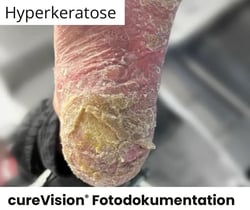
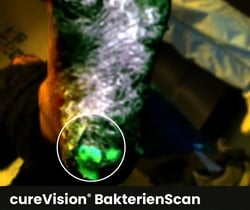
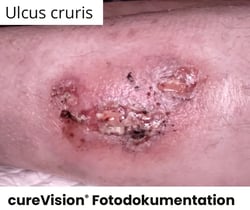
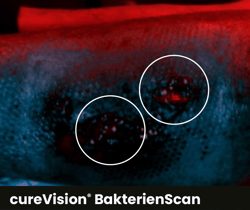
With the help of the BacteriaScan, areas with bacterial contamination become immediately visible. Highlighted green areas indicate increased bacterial load in hyperkeratosis. Highlighted red areas in leg ulcers clearly show bacterial activity.
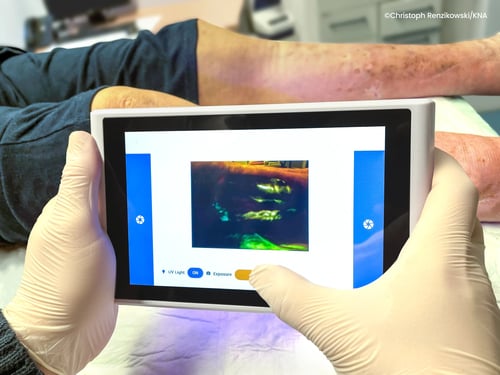
Perform the BacteriaScan even in daylight!

Reduce costs and increase patient satisfaction
Detect possible bacterial infections in the wound at the touch of a button. Assess the need for cost-intensive wound care - clearly traceable using our documentation.
Making Bacteria visible even in the wound environment
The BacteriaScan visualizes the bacterial load in the wound and its surrounding area in red or green. This allows you to detect bacterial contamination at an early stage and minimize the risk of infection.
Improve the quality of wound cleansing
Wound cleansing or debridement can leave behind large amounts of bacteria. Fluorescence images help to identify these areas and optimize cleansing for the best possible wound healing.
Precise Swab Collection
Heavily colonized areas glow, enabling targeted swabs to be taken.
This allows you to optimize your swabs and save costs at the same time.
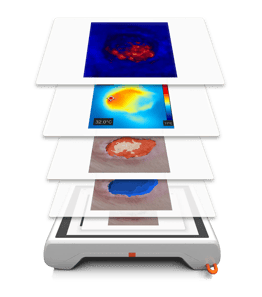
Create a Clear Data Basis for Billing
With the BacteriaScan, you can see at a glance whether antibacterial wound dressings are necessary. Our all-in-one wound analysis provides you with objective evidence for every invoice.
Do I have to darken the room to be able to use the scan?
No, the cureVision system does not require the room to be completely darkened.
However, you should avoid direct sunlight on the area to be examined, as otherwise the fluorescence signals may be masked.
Are the bacteria in wound pockets also recognized?
Yes, our solution can also visualize the bacterial load in wound pockets! The prerequisite for this is that these areas are well illuminated with UV lighting and are visible to the camera.
The better the accessibility and illumination of the wound pocket, the more reliable the visualization.
In this way, our solution helps you to effectively assess even hard-to-access wound areas and optimally control the treatment.
Can the system also calculate the bacterial load?
Our solution makes areas with a increased bacterial load visible to you by highlighting them in red or green using fluorescent signals.
This gives you a reliable visual assessment at a glance of where there is an increased bacterial load. However, it does not provide an exact numerical determination of the number of bacteria.
The color coding helps to immediately identify critical areas and to optimize subsequent treatment.
Up to what sensitivity level can the system detect the bacterial load?
Our system detects bacterial contamination on the wound surface from a threshold of around 10⁴ CFU/g (colony-forming units per gram of tissue). The intensity of the fluorescence signal reflects the density of the bacteria.
This gives you a quick and clear visual assessment of how heavily the wound is contaminated with bacteria - and allows you to respond to the situation in a targeted and efficient manner.
Does the system also recognize the specificity of the bacteria in the wound?
However, the colour visualization of our system supports you in quickly and specifically identifying potentially problematic areas and optimally initiating further diagnostics or treatment.
How does bacterial fluorescence detection work?
The multispectral imaging unit uses violet LED light, which is harmless to health, to stimulate bacterial metabolites, especially porphyrins or pyoverdins. These emit a red or green fluorescent signal, which cureVision detects using special filters and sensors. Proprietary algorithms enhance the contrast and filter out interfering background signals. Various types of tissue, such as the cornea, nails, bones, or fungi, can also fluoresce green.
By specifically detecting porphyrin- or pyoverdin-associated fluorescence, increased bacterial loads exceeding a clinically relevant colonization of 10 CFU/g can be precisely visualized. The results appear as a fluorescence image in which red or green glowing areas may indicate increased bacterial activity.
How does the BacteriaScan support therapy planning?
Imaging with the BacteriaScan can provide evidence for bacteria-specific treatment of the wound. The fluorescence image is automatically saved in the wound report, thus supporting treatment decisions.